The Paper Fallacy: Why a Certificate of Authenticity Tells You Less Than You Think
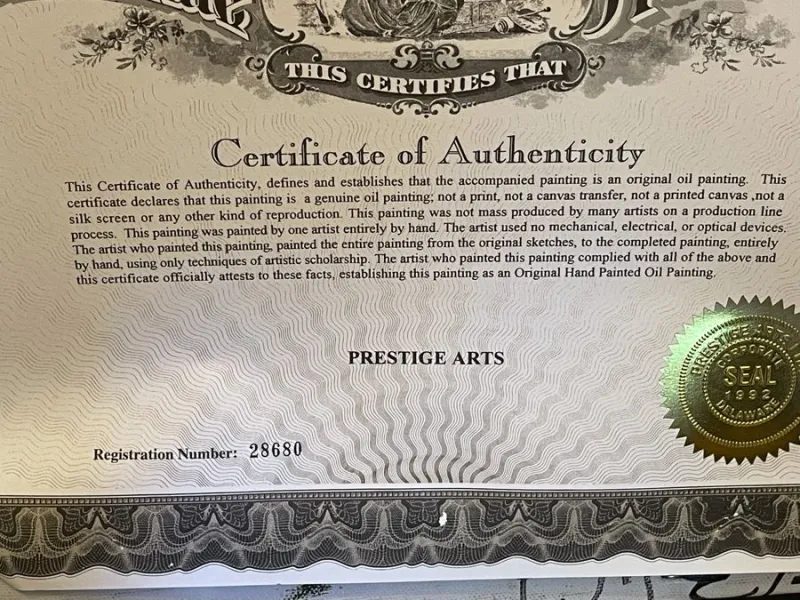
Photo: close-up of certificate of authenticity document next to framed painting, via savacoolandsons.blob.core.windows.net
Somewhere in America right now, a collector is paying a premium for a work of art because it comes with a certificate of authenticity. And somewhere in that same transaction, a false sense of security is changing hands.
It is time to say plainly what much of the trade already knows: the certificate of authenticity, as commonly practiced, is among the most misunderstood documents in the art market. It is not a guarantee. It is not a warranty. In many cases, it is barely evidence at all.
One Document, Many Meanings
The core problem is that 'certificate of authenticity' is not a standardized instrument. There is no regulatory body in the United States that governs who may issue one or what it must contain. In practice, the same phrase covers documents of wildly different authority:
- A self-issued statement by an artist or the artist's own gallery, attesting to their own work — useful, but only as strong as the issuer's standing.
- A dealer's certificate, often produced at the time of sale by the same party with a financial interest in the transaction.
- A foundation or committee ruling, issued after formal review by the recognized authority on the artist's work.
- A catalogue raisonné reference, the closest thing the art world has to a definitive record.
A buyer who treats the first category as equivalent to the last is not performing due diligence. They are collecting letterhead.
The Conflict of Interest Problem
Consider who typically issues certificates in the primary market: the seller. A certificate from a gallery selling the work is not an independent verification — it is a seller's representation, no more and no less. When disputes arise years later, such certificates have repeatedly proven to be worth precisely the credibility of the party behind them.
Contrast this with the foundation model. The recognized authentication boards for major artists have historically been deliberate to the point of frustration, rejecting far more submissions than they confirm. That reluctance is a feature. An authority that says yes to everything is an authority that means nothing.
Three Questions Before You Trust Any Certificate
Rather than dismissing certificates outright — which would overcorrect — collectors should subject every one to three questions.
First: Who issued it, and what do they have to lose? A ruling from an independent foundation with a reputation to protect carries weight. A certificate from the party selling the work carries, at minimum, a conflict of interest that must be acknowledged.
Second: What, specifically, does it attest to? Does the document confirm authorship outright, or does it hedge with language like 'attributed to' or 'in the style of'? Does it address provenance, or only the object? Precision in the wording is a reliable indicator of rigor behind it.
Third: What supports it beyond the paper? The strongest certificates point to something external — inclusion in a catalogue raisonné, a documented exhibition history, a matching entry in the artist's own records. A certificate that stands alone, referencing nothing verifiable, proves only that someone printed a document.
The Market's Incentive Problem
Why does the paper fallacy persist? Because it serves the market. Certificates are cheap to produce and effective at closing sales. A nervous first-time buyer handed an official-looking document often stops asking questions — and the questions are where problems get found.
Buyers, particularly American buyers new to the market, should internalize an uncomfortable truth: the certificate is a marketing document far more often than it is a verification document. The verification lives elsewhere — in provenance records, in scholarly literature, in the issuer's independent standing.
Trust the Trail, Not the Page
None of this is to say collectors should ignore certificates. A certificate from a recognized foundation is a meaningful data point, and a self-issued artist certificate for contemporary work has real value. The error is not in reading the certificate; it is in stopping there.
Authenticated art earns its status through a documented chain — of ownership, of scholarship, of expert consensus built over time. A single sheet of paper, however official it looks, is at best a summary of that chain and at worst a substitute for it. Collectors who learn to ask the three questions above will not avoid every risk. But they will stop paying premiums for paper, and start paying for what actually matters: verified legacy.