Interrogate the File: Seven Questions That Reveal Whether Provenance Papers Hold Up

Photo: OpheliaTheatreGroup, CC BY-SA 3.0, via Wikimedia Commons
Every experienced dealer has seen it: the handsome binder, the embossed certificates, the typed provenance line stretching back four generations in elegant chronological order. It looks impeccable. And sometimes it is. But presentation and substance are different virtues, and the documentation accompanying a serious purchase deserves the same scrutiny as the object itself.
The following seven questions function as a diagnostic. They are not a substitute for expert review, but they will tell you quickly whether the file in front of you merits one.
1. Is the Chronology Continuous, or Merely Convenient?
Strong answer: Gaps exist but are acknowledged, explained, and bounded in time — a work in a single family's collection from 1952 to 1988, with estate settlement papers to show for the transition.
Red flag: A seamless list with no supporting documents at all, or gaps that conveniently span the very decades — wartime, in particular — when documentation was most likely to be lost or, less innocently, fabricated.
2. Who Are the Named Sources, and Can They Be Checked?
Strong answer: The provenance names dealers, galleries, and collectors whose existence and activity can be independently verified through trade records, exhibition catalogues, or published correspondence.
Red flag: Vague designations ("private collection, Europe"), names that appear in no other record, or a chain built entirely on parties who cannot be contacted or confirmed.
3. Does the Physical Evidence Match the Paper?
Strong answer: Stretcher marks, lining, frame profiles, and labels on the verso correspond to what the documents describe, and any discrepancies have been reconciled in writing by a conservator.
Red flag: An exhibition label for a 1974 museum show affixed to a stretcher that, per the condition report, was replaced in 1990. Small contradictions in physical evidence are how larger problems announce themselves.
4. What Does the Exhibition History Actually Demonstrate?
Strong answer: Documented exhibitions at institutions whose records survive and can confirm the loan — catalogues with the work illustrated, checklists, correspondence files.
Red flag: Exhibition claims that cannot be located in institutional archives, or a history heavy on commercial gallery shows and light on anything verifiable.
5. Has the Attribution Been Tested Against the Literature?
Strong answer: The work appears in a catalogues raisonné, or its absence from one is explained; scholarly opinions are cited by name, with dates, and any past disagreements are disclosed rather than buried.
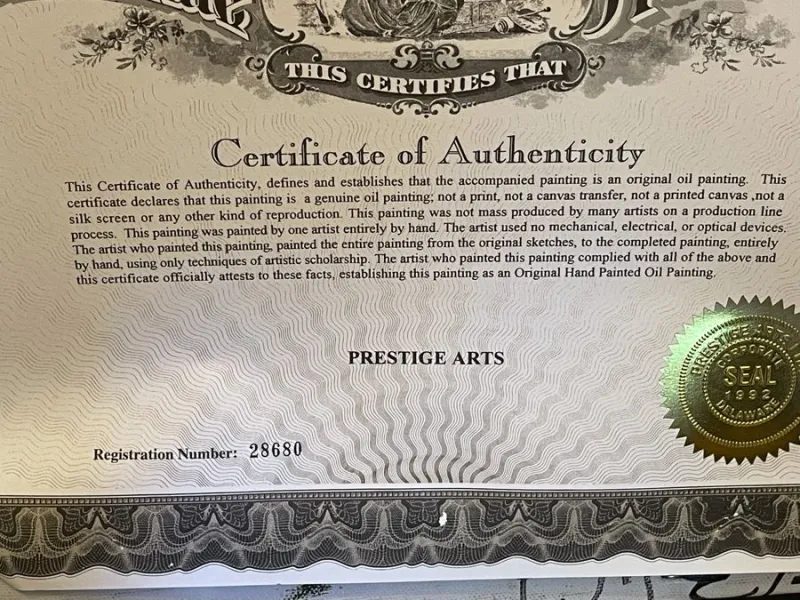
Red flag: A certificate from an entity with no scholarly standing, or an authentication whose author is deceased, unreachable, or commercially entangled with the seller.
6. Are the Documents Consistent With Each Other?
Strong answer: Dates, dimensions, titles, and names align across bills of sale, insurance appraisals, and shipping records, with any variations explained by ordinary clerical drift.
Red flag: The same painting described with two different sets of dimensions across documents — a detail that has unmade more than one forged provenance.
7. What Is the Seller's Relationship to This File?
Strong answer: The seller can describe how the documentation was assembled, when it was compiled, and who was paid to produce it.
Red flag: A file that materialized recently, in polished form, just ahead of a sale — especially if it was assembled by the same party who stands to profit from the buyer's confidence in it.
The Habit Behind the Questions
Notice what all seven have in common: each asks the file to be corroborated from the outside. A provenance that cannot survive contact with independent records — archives, auction databases, institutional registries, conservation science — is not yet a provenance. It is a claim.
Collectors who internalize this habit find that the questions become second nature, and that sellers of quality increasingly welcome them. In a market where documentation can be manufactured as easily as an object, the disciplined question is the collector's most portable and least expensive tool.