The Honest Gap: Why an Incomplete Ownership History Can Signal Authenticity Rather Than Alarm
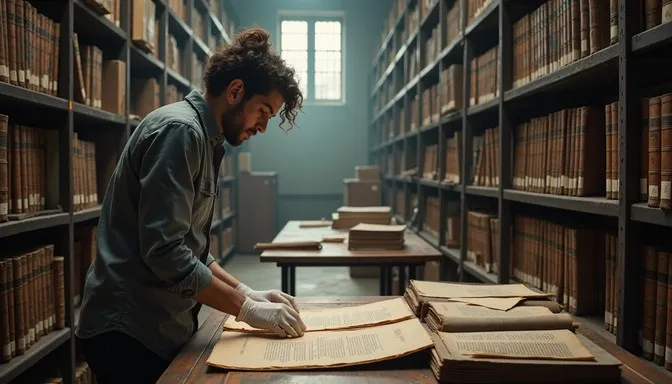
Photo: art historian examining old painting documents and provenance records in archive, via images.stockcake.com
The Assumption That Silence Means Concealment
For much of the past two decades, the collecting world has operated under a fairly blunt principle: the more complete the provenance, the more trustworthy the work. This instinct is understandable. High-profile cases involving looted art, fraudulent ownership chains, and fabricated documentation have made collectors—and their legal counsel—appropriately cautious about works that cannot account for every decade of their existence.
But caution, taken to its logical extreme, produces a paradox. If a flawless provenance record is always preferred, the market inadvertently creates incentives for forgers and bad actors to produce exactly that: seamless, fabricated histories that satisfy scrutiny precisely because they have been engineered to do so. Meanwhile, works with honest but incomplete records—pieces that genuinely passed through private hands during periods of upheaval, or that sat quietly in family collections without the benefit of formal documentation—become artificially disadvantaged.
A growing constituency of scholars, dealers, and sophisticated collectors is pushing back against this overcorrection. Their argument is not that gaps in provenance should be ignored. It is that gaps, properly understood, are historical data rather than red flags—and that the nature of a gap matters far more than its mere existence.
Underdocumented Is Not the Same as Undisclosed
The distinction at the center of this conversation is one that specialists in the field have articulated with increasing precision: there is a meaningful difference between provenance that is incomplete and provenance that is actively obscured.
An incomplete record might reflect the realities of estate dispersal, the habits of a private collector who never sought public attention, the disruptions of wartime Europe, or simply the indifference of earlier owners to formal documentation. These are historical conditions, not moral failures. When a seller or auction house presents such a record honestly—acknowledging what is known, what is unknown, and what research has been undertaken to address the gaps—that transparency is itself a form of integrity.
Obscured provenance is something else entirely. It involves the active suppression or misrepresentation of ownership history: the deletion of names, the alteration of dates, the substitution of invented custodians for actual ones. This is the category that warrants alarm, and it is distinguishable from honest incompleteness by precisely those qualities of transparency and research effort that reputable sellers demonstrate.
For collectors, developing the ability to read this distinction is not merely academically interesting. It is practically consequential.
Historical Gaps With Legitimate Explanations
Certain periods and circumstances produce provenance gaps as a near-inevitable byproduct of historical conditions. Works that passed through private European collections during the 1930s and 1940s frequently carry ownership records that are fragmented, ambiguous, or entirely absent for the war years—a reality that has generated enormous scholarly and legal attention, and rightly so. But the same fragmentation also affects works that were simply held by families who moved, died without wills, or dispersed collections informally across generations.
In the American context, works acquired during the mid-twentieth century by collectors outside major urban centers often lack the institutional paper trail that gallery records and auction catalogues provide. A painting purchased directly from an artist in 1952, held in a private home in the Midwest for sixty years, and then donated to a grandchild presents a provenance gap that is entirely consistent with legitimate ownership—and entirely unremarkable to anyone familiar with how art actually circulates outside the formal market.
The relevant question is not whether documentation is absent for a given period, but whether the explanation for that absence is historically plausible, honestly presented, and supported by whatever circumstantial evidence is available.
When Gaps Become Part of the Discovery Narrative
Some of the most compelling acquisitions in recent American collecting history have involved works whose provenance gaps were ultimately resolved through research conducted after purchase—or whose gaps, though never fully closed, were rendered credible through a combination of material analysis, stylistic scholarship, and contextual documentation.
This is where the intersection of forensic science and historical research becomes particularly valuable. When a work cannot be traced through exhibition records or sales receipts, material analysis can often establish whether the work's physical characteristics are consistent with the claimed period and attribution. A painting that cannot be documented in any catalogue raisonné but whose pigments, canvas, and underdrawing are entirely consistent with an artist's authenticated output occupies a very different evidentiary position than one whose material evidence contradicts its claimed history.
In this sense, the absence of documentation is not a terminus. It is an invitation to scholarship. And works that survive that scholarly scrutiny with their attributions intact often emerge with something that a seamlessly documented work cannot offer: a demonstrated resilience to investigation.
What the Market Is Learning to Recognize
The broader collecting market—particularly among institutions and sophisticated private buyers—is gradually developing a more calibrated vocabulary for discussing provenance quality. Rather than treating completeness as the sole criterion, experienced buyers are asking a different set of questions: What research has been done to address the gaps? Are the gaps consistent with known historical conditions? Does the physical evidence support or contradict the claimed attribution? And has the seller been forthcoming about what is not known?
This shift has practical implications for valuation as well. Works that arrive with honest, well-researched provenance records—even incomplete ones—are increasingly regarded as more credible than those with suspiciously complete histories that have not been independently verified. The market, in other words, is beginning to price transparency rather than simply completeness.
For auction houses and private dealers operating at the higher end of the American market, this represents both a challenge and an opportunity. The challenge is the additional research investment required to present incomplete provenance records responsibly. The opportunity is the differentiation that comes from doing so—from being the source that collectors trust precisely because it does not oversell certainty it does not possess.
Collecting With Open Eyes
The collector who insists on complete documentation for every acquisition will, over time, find himself holding a collection shaped less by genuine quality than by the accidents of paperwork. Some of the finest works in private American hands today carry provenance records with unexplained intervals—not because their histories are tainted, but because history itself is rarely as orderly as collectors might wish.
The wiser approach is one that treats provenance as a living inquiry rather than a closed file. It demands honesty from sellers, supports ongoing research, engages forensic tools where appropriate, and recognizes that a well-explained gap is frequently more trustworthy than a too-perfect trail.
Authenticity, in the end, is not synonymous with documentation. It is a quality confirmed through the convergence of multiple forms of evidence—material, historical, and scholarly. When that convergence is present, even an incomplete ownership record can be the beginning of a genuinely important acquisition.